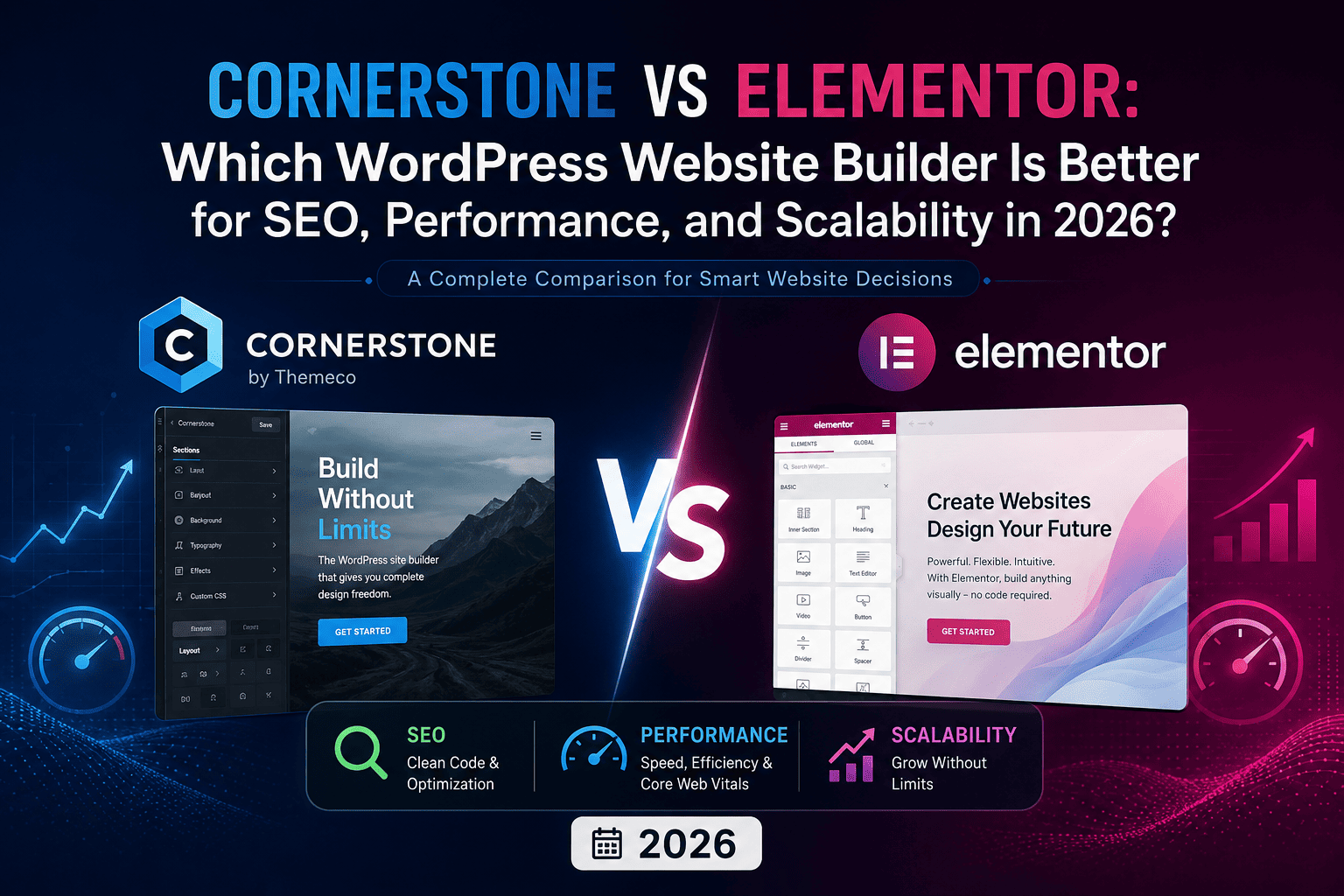
Cornerstone vs Elementor: Which WordPress Website Builder Is Better for SEO, Performance, and Scalability in 2026?
Choosing the best WordPress page builder is no longer just about drag-and-drop design. In 2026, website owners care about:
- Google Core Web Vitals
- Technical SEO
- Website speed
- Clean HTML output
- Scalability
- Dynamic content
- Long-term maintainability
That’s why the debate around Cornerstone vs Elementor has become increasingly important for developers, agencies, and SEO-focused businesses.
While Elementor dominates the WordPress ecosystem because of its beginner-friendly interface, Cornerstone is gaining attention as a high-performance Elementor alternative built for scalable websites and modern SEO requirements.
In this detailed comparison, we’ll break down:
- Cornerstone vs Elementor performance
- Which builder is better for SEO
- Dynamic content capabilities
- Design systems and reusable components
- Developer experience
- Which page builder is best for long-term WordPress projects
Cornerstone vs Elementor: Quick Comparison
| Feature | Elementor | Cornerstone |
|---|---|---|
| Ease of Use | Beginner-Friendly | Developer-Oriented |
| HTML Output | Heavy Wrapper Structure | Clean Semantic HTML |
| Website Speed | Requires Optimization | Lightweight by Default |
| Dynamic Content | Basic Dynamic Tags | Advanced Query System |
| API Integration | Limited | Native Support |
| Component System | Global Widgets | Parameterized Components |
| SEO Performance | Moderate | Strong Technical SEO |
| Scalability | Medium | Enterprise-Level |
| Developer Flexibility | Limited | Extensive |
| Best For | Quick Website Builds | Performance-Focused Websites |
Why More Developers Are Switching from Elementor to Cornerstone
Many websites built with Elementor eventually face problems related to:
- Slow page speed
- Excessive DOM size
- Plugin dependency
- Design inconsistency
- Difficult scaling
- Technical SEO limitations
Cornerstone addresses these issues with a system-first architecture designed for modern web performance.
1. Cornerstone vs Elementor for SEO
Why SEO-Friendly Website Builders Matter
Search engines now prioritize:
- Fast-loading pages
- Semantic HTML
- Mobile performance
- Accessibility
- Structured content hierarchy
- Core Web Vitals
Your page builder directly impacts all of these ranking factors.
Elementor SEO Limitations
Elementor relies heavily on nested <div> wrappers and JavaScript rendering. While visually flexible, this can create:
- Large DOM sizes
- Slower rendering
- Additional CSS/JS requests
- Reduced performance scores
These issues can negatively impact:
- Largest Contentful Paint (LCP)
- Interaction to Next Paint (INP)
- First Contentful Paint (FCP)
For SEO-driven websites, this often means extra optimization work using:
- Caching plugins
- Asset management tools
- Performance plugins
- CDN configurations
Cornerstone’s SEO Advantage
Cornerstone outputs clean semantic HTML5 with fewer unnecessary wrappers.
Benefits include:
- Better crawlability
- Improved accessibility
- Faster page rendering
- Cleaner source code
- Lower DOM complexity
This gives Google and AI-driven search engines a clearer understanding of your page structure.
Why Semantic HTML Matters for Google Rankings
Semantic HTML improves:
- Content hierarchy
- Indexing efficiency
- Featured snippet eligibility
- Accessibility compliance
- AI content interpretation
As search evolves toward AI-generated summaries and LLM-based indexing, structured HTML becomes even more important.
SEO Winner: Cornerstone
For technical SEO and performance optimization, Cornerstone provides a stronger foundation.
2. Website Speed and Core Web Vitals
Elementor Performance Challenges
Elementor websites can become slow due to:
- Multiple wrapper elements
- Heavy frontend scripts
- Third-party add-ons
- Unoptimized widget loading
Large Elementor websites often require extensive tuning to achieve good PageSpeed scores.
Cornerstone Performance Benefits
Cornerstone follows a lightweight rendering philosophy.
Key advantages:
- Minimal frontend overhead
- Reduced CSS bloat
- Faster HTML parsing
- Cleaner asset loading
This helps improve:
- Google PageSpeed Insights scores
- Mobile usability
- User experience
- Conversion rates
Why Faster Websites Rank Better
Google uses page experience signals as ranking factors. Faster websites typically achieve:
- Lower bounce rates
- Higher engagement
- Better crawl efficiency
- Improved conversion performance
If website speed is critical to your business, Cornerstone offers a major advantage.
3. Dynamic Content and Query Builder Comparison
Elementor Dynamic Content Features
Elementor supports:
- Dynamic tags
- Custom field integrations
- Basic post queries
However, advanced functionality usually requires:
- Extra plugins
- Custom coding
- Third-party integrations
This increases complexity and maintenance costs.
Cornerstone Dynamic Content Features
Cornerstone includes a native visual query builder capable of:
- Nested loops
- Conditional logic
- API-based content
- Dynamic relationships
- Custom post queries
Example Use Cases
You can build:
- Real estate listings
- Membership platforms
- Directory websites
- Dynamic blogs
- Product databases
- Job boards
without relying heavily on third-party add-ons.
4. Cornerstone Components vs Elementor Templates
Elementor Templates and Global Widgets
Elementor offers reusable templates and widgets, but scaling large websites can become difficult.
Common issues include:
- Style inconsistency
- Manual updates
- Repetitive editing
- Limited parameter control
Cornerstone’s Component-Based Architecture
Cornerstone treats websites more like software systems.
You can create reusable components with:
- Dynamic parameters
- Flexible content fields
- Centralized management
- Consistent styling
Why This Matters for Large Websites
Component systems help:
- Maintain branding consistency
- Speed up development
- Reduce human error
- Simplify updates
For agencies managing dozens or hundreds of pages, this becomes a huge operational advantage.
5. Developer Experience and Extensibility
Elementor Is Built for Designers
Elementor focuses primarily on visual editing and ease of use.
While developers can extend it, advanced customization often requires workarounds.
Cornerstone Is Built for Developers
Cornerstone includes:
- Twig templating support
- Raw field access
- API-driven architecture
- Custom rendering control
- Granular styling capabilities
This makes it ideal for:
- Advanced WordPress development
- Custom applications
- Structured content platforms
- Headless workflows
Twig Templating in Cornerstone
Twig support is one of Cornerstone’s biggest advantages for developers.
Benefits include:
- Cleaner code organization
- Better maintainability
- Separation of logic and presentation
- Faster development workflows
This creates a more professional development environment compared to traditional page builders.
6. Which Builder Is Better for Long-Term Scalability?
Elementor Works Best For:
- Freelancers
- Landing pages
- Small business websites
- Quick client projects
- Beginner users
Cornerstone Works Best For:
- Enterprise WordPress websites
- SEO-focused businesses
- Performance-critical projects
- Complex dynamic websites
- Agencies building scalable systems
Is Cornerstone the Best Elementor Alternative?
If your priority is:
- Quick visual editing
- Simplicity
- Large template libraries
then Elementor remains a strong option.
But if your focus is:
- Technical SEO
- Website performance
- Semantic HTML
- Scalability
- Dynamic content
- Developer flexibility
then Cornerstone is one of the best Elementor alternatives available today.
Final Verdict: Cornerstone vs Elementor
The real difference between Cornerstone and Elementor is philosophy.
Elementor is designed to help users build pages quickly.
Cornerstone is designed to help developers build scalable, maintainable, high-performance web systems.
As Google increasingly rewards:
- Fast websites
- Clean markup
- Structured content
- Strong Core Web Vitals
the advantages of Cornerstone become more significant.
If you are building a long-term website that depends on SEO, performance, and scalability, Cornerstone offers a future-ready foundation that goes far beyond traditional page builders.
Frequently Asked Questions
Is Cornerstone better than Elementor for SEO?
Yes. Cornerstone provides cleaner semantic HTML and better performance optimization, which helps technical SEO and Core Web Vitals.
Which page builder is faster: Cornerstone or Elementor?
Cornerstone is generally faster because it produces lighter frontend output with fewer unnecessary wrappers.
Is Elementor easier for beginners?
Yes. Elementor has a more beginner-friendly drag-and-drop interface.
Does Cornerstone support dynamic content?
Yes. Cornerstone supports advanced dynamic content, visual query building, API integrations, and reusable components.
Which builder is better for developers?
Cornerstone is significantly more developer-friendly due to Twig templating, semantic control, API access, and extensibility.